



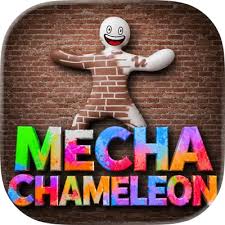

What is Meccha Chameleon?
Meccha Chameleon is a co-op/competitive hide-and-seek title with one core twist. In the hide-and-seek games most people know (think Prop Hunt), hiders usually transform into preset objects. Meccha Chameleon does it differently: instead of turning into an object, you manually paint your character's plain white body to blend into the background.
The game was created by Japanese indie developer Lemorion_1224, who built it in about two months. This isn't a first-timer, though: Lemorion_1224 quietly spent years inside Fortnite's Creative mode developing hide-and-seek concepts focused on disguise, camouflage and social deception before bringing them to a standalone Steam release. He announced the game on Steam on May 15, 2026 and launched it on June 9, 2026.
How to play Meccha Chameleon
Each match splits players into two teams: Hiders and Seekers. The fun lives in the camouflage step. Players use RGB sliders, an eyedropper tool and other color settings to match their body to the floor or walls, and can even adjust their pose to hide perfectly. In other words, your "artistic skill," choice of hiding spot and pose all decide whether you get spotted.
Key features worth noting:
- Manual camouflage, no preset models. You paint colors and patterns onto your body to mimic the walls, floors and objects around you — much like using an eyedropper tool in Photoshop.
- Multiplayer support. Play with friends in a private room or open a public server to play with strangers; the maximum player count depends on the host's network, with 2–10 players recommended.
- Streamer-friendly. The game suits party nights, casual meetups and viewer-participation streams, with clear roles and a round timer driving the pace.
- Two camera views and extra content. It supports both third-person (TPP) and first-person (FPP) views; Steam Workshop and official modding tools let players publish custom maps.
For PC controls, the game uses WASD to move, F to open the paint menu, R to open the pose menu, plus the eyedropper to sample colors from the environment.
Why did Meccha Chameleon blow up?
This is one of Steam's most surprising success stories of 2026. Meccha Chameleon sold 3 million copies in seven days and took the No. 1 spot on Steam's global sales chart on June 17, 2026 — outselling both Forza Horizon 6 and Destiny 2, with no publisher, no marketing budget and no press campaign.
The sales pace is almost unheard of for an indie game. After launching on the 10th, it sold 500,000 copies in two days, hit 1 million on the 14th, 2 million on the 15th and 3 million on the 17th — meaning it moved another million copies in roughly 26 hours. Concurrent player numbers were just as striking: the game peaked at 209,667 concurrent players on June 16 and 17 — a figure that places it inside Steam's all-time top 100 for peak concurrent users, a list otherwise dominated by Counter-Strike 2, PUBG and Dota 2.
Much of the early momentum came from streaming. The game peaked at over 127,000 viewers on Twitch on launch day, June 10, as big streamers showed off their chaotic painting matches. A simple, funny, watchable premise turned viewers into buyers, and those buyers generated the next wave of clips.
Two factors combined to create the phenomenon: a genuinely original idea and a very low price. In terms of genre, Meccha Chameleon fits the "friendslop" label — a community term for cheap, casual multiplayer games designed mainly for friend groups, where the value is the social experience rather than mechanical depth; notable examples include Lethal Company, REPO and Content Warning.
Quick verdict: strengths and weaknesses
After a week on sale, player feedback is broadly positive. The game currently holds a Mostly Positive rating on Steam; most reviews say it's plenty of fun for its affordable price, and players enjoy the mix of casual, hilarious gameplay with a bit of challenge for both hiders and seekers. The downsides get named honestly too: some players feel the UI holds the game back and can occasionally make things harder than they need to be.
In short, this is more of a "fun with friends" game than a deep competitive title. If you have a group of friends and want a few rounds of laughs, the value for money is excellent. If you're after a serious, mechanically deep competitive game, set your expectations accordingly.
If you enjoy fun co-op games to play with a group of friends, a few titles in the same "friendslop" vein are often mentioned alongside Meccha Chameleon: Lethal Company, REPO and Content Warning — prime examples of cheap, socially-driven multiplayer games. The Prop Hunt family (on Garry's Mod and its spin-offs) is the closest relative in terms of disguise-based hide-and-seek, though it uses transforming into preset objects rather than painting yourself.